Issue 6, July 2000

|
Humans
vs. Robots by Vesna Nikolic
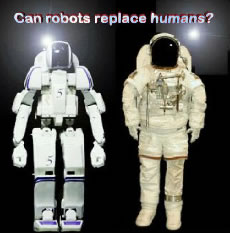
Space is a very dangerous place, especially for astronauts doing EVA’s (ExtraVehicular Activity - NASA’s term for spacewalking). So, people might ask themselves, why don’t we replace humans with robots? There is no atmosphere to protect astronauts and their spacecrafts from the cruel environment of space. The temperatures can get as high as 300F (about 150C) in the sunlight and –200F (about –130C) in the shade. If a human were exposed, the lack of pressure could cause bursting blood vessels. Micrometeoroids and space debris traveling at high speeds can penetrate human skin and thin metal. Other environmental factors include high-energy particles from the Sun, and radiation. In order to perform an EVA, an astronaut has to wear a spacesuit in order to protect himself from this environment, and spend a lot of time in preparation for EVA. Spacesuits are 14 layered garments custom built for every astronaut. They provide breathing air, pressure and temperature control for the astronauts. Currently, spacesuits are heavy and motion limited, therefore making every EVA a very hard physical task, which could potentially take hours. In space, there is no weight. Astronauts can drift in space by simply pushing themselves off the spacecraft. Tethers and AMU’s (Astronaut Maneuvering Units) have to be used in order to get back to the spacecraft. BAT (Beam Assembly Teleoperator) is a robot that assists astronauts in EVA’s by bringing tools, orbital replacement units, and performing rescue to potentially consciousness astronauts. But why spend money on making this robot, and why waste space on board of the spacecraft, and the fuel to get the robot to orbit, just so that it can serve as a an assistant? Why not just add a few more components to that robot and then make it do the repairs on its own? In 1997, two astronauts spent 6 hours in EVA with a mission to catch a 3,000-pound, slowly spinning satellite with their own hands. The question is, why do we risk human lives, and thousands of dollars of equipment for protecting their lives, in order to perform a single EVA repair mission? Why not just use robots? Then, humans could stay in a protected environment controlling those robots. Robots would be like mobile shuttle arms. Honda has made a humanoid robot that can walk on two legs and perform some specific human duties (like tight a bolt, or cut a tie), so why not use an already made robot? We could add a few jets on its side in order to move the robot if it gets too far away from the spacecraft (the robot could be either moved towards the spacecraft, or towards the Earth in order for the robot to burn in the atmosphere). We could also add suction cups on its legs. The suction cups would help the robot move when it’s close to the spacecraft (the robot would basically climb the spacecraft), and they would also provide security when repairing components (so that the robot doesn’t move by the force opposite of its motion). With a few minor changes to this already made robot, we could save the astronauts the danger of EVA. Now what are some advantages of having robots instead of humans performing EVA’s? Robots don’t need spacesuits. Robots don’t need to spend a lot of time in preparation for EVA. If a meteoroid penetrates through the metal, the robot would not die, but instead be repaired. If a robot gets too far away from the spacecraft, it can be brought back by smaller jets, or it could be let to burn in the Earth’s atmosphere. NASA and other space agencies are currently working on a similar project called the “Robonaut” (check the 1999 article by SpaceDaily at http://www.spacedaily.com/news/robot-99h.html [link updated - SM]). This is basically a robot that will replace humans in EVA’s. Unfortunately, there is not enough information given to the public about this robot. A few people would argue that robots couldn’t replace humans, because of the complexity of human chores. The shuttle arm and the new arm on the future ISS are two robotic components that prove that robots can replace humans in some chores. Can we make these components a little bit smaller and make them detachable, and help protect our astronauts from the long EVA repair missions? What will be the role of astronauts then? Astronauts could, besides doing various scientific and technological experiments on board of the spacecraft, control the robots from inside the protected environment. Also, if there are situations that robots cannot handle, humans can always handle them.
|